Subul connects international employers with freelance talent in markets that global payment networks do not serve, routing the work directly and the money through local agency partners who settle on the ground.

Challenge
Subul places refugee and displaced tech talent with companies across Europe, and by 2023 the model had proven itself across thousands of placements. It also ran almost entirely on forms, spreadsheets and email. Every new client meant more manual coordination, and every cross-border hire was assembled by hand: contracts, onboarding, local employment, payment schedules. The talent pool was ready to grow. The operation around it was not.
Service
Product, Brand, Character design, Frontend
Role
I led product, brand, UX and character design, and built the frontend. Akmal built the backend and memory.


Strategy
Subul is not a marketplace, and building it as one would have been a mistake. Companies sign with Subul first and get access to the talent pool afterwards, so the platform never had to compete for open-market liquidity. That freed the design to solve the actual problem, which is that a hire here involves three parties rather than two: the client, the professional, and the local partner who employs them on the ground.


Solution
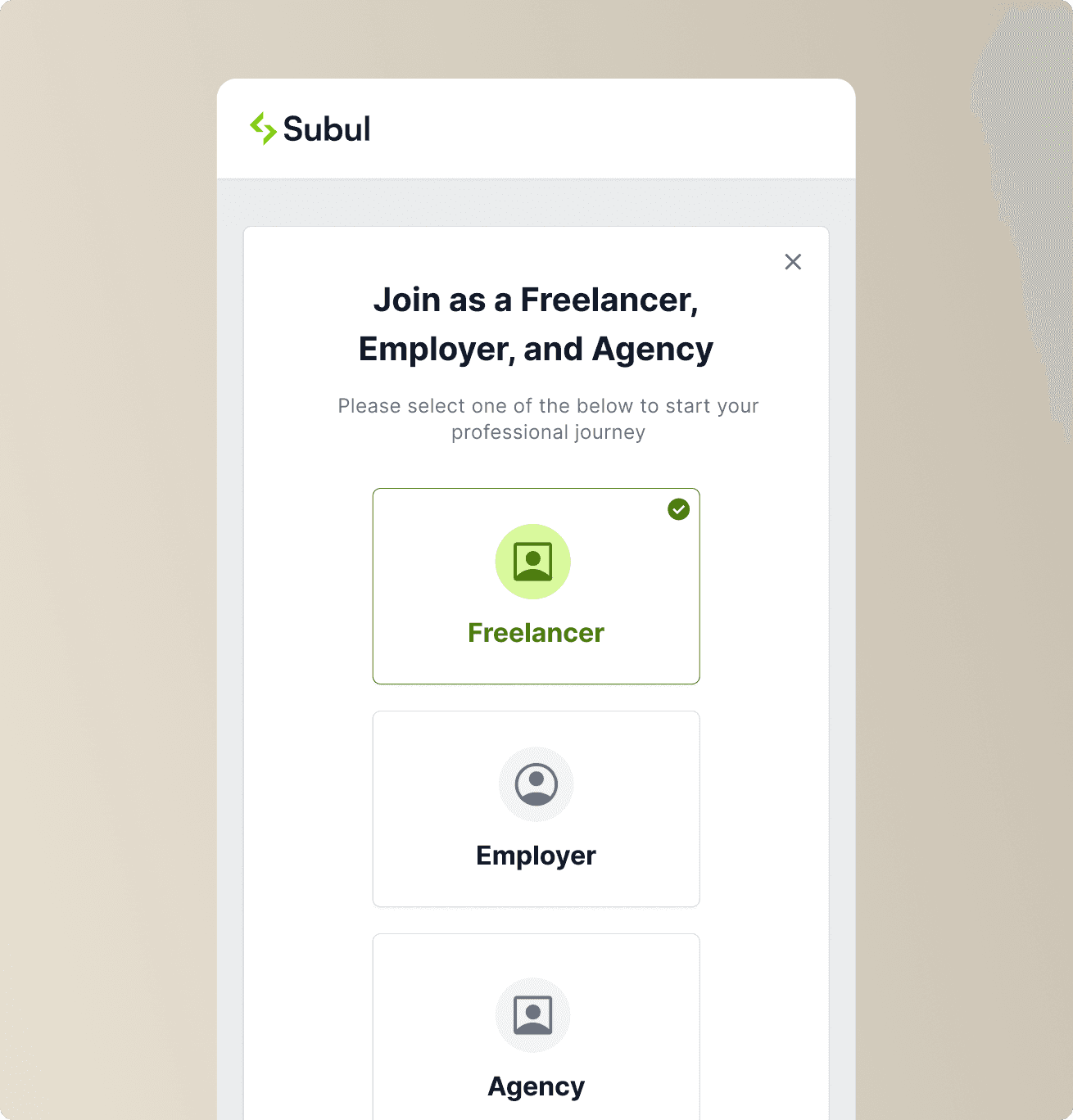
A three-party arrangement creates more places for things to go wrong, so the structure had to be visible in the product rather than buried in a contract. Each onboarding ends where that actor sits in the arrangement. Clients finish at billing details, local partners at payout details, and professionals by joining a partner who takes them on. Terms are set per engagement rather than per account, because one client often works across several countries.


Outcome
Three kinds of user, one way of speaking. Professionals, clients and local partners each get their own sign-up, dashboard and profile, all drawn from a single component library and two grids, so a three-sided system still reads as one product. Job status lives in tabs rather than separate pages: invited, applied, active, completed. Earnings stay off public profiles. Complexity sits with the partner, and what the client sees is simply a hire.


